Atheist Ireland promotes ethical secularism in Ireland and internationally, based on human rights principles such as freedom of conscience and belief, freedom of expression, freedom from discrimination, equality before the law, and the right to an effective remedy.
We led the successful campaign to remove Ireland’s constitutional ban on blasphemy, we were part of the campaigns for marriage equality and abortion rights, and we seek an objective, critical, and pluralistic education system free from religious discrimination.
You can search below to read our advocacy documents by year, by topic (education, politics, secularism), and by region (national or international).
Atheist Ireland is a member of the dialogue process under the Lisbon Treaty between the Irish government and religious and philosophical bodies. We lobby politically, and make submissions and presentations to:
- Political parties, Oireachtas members, Government ministers, Government departments, the Attorney general, and the Comptroller and Auditor General.
- The joint Oireachtas committees on Education, Health, Justice, Public Accounts, Public Petitions, Local Government, and Social Protection.
- The Irish Human Rights and Equality Commission, the National Council for Curriculum and Assessment, Education and Training Boards Ireland, the Broadcasting Authority of Ireland, the Standards in Public Office Commission, and the Ombudsman for Children.
- Public consultation bodies including the Constitutional Convention and Citizen’s Assemblies.
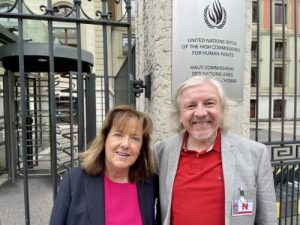
Atheist Ireland has special consultative status at the United Nations. We are the first national atheist body to attain such status.
We lobby, and make submissions and presentations to the human rights oversight bodies at the United Nations, Council of Europe, and Organisation for Security and Cooperation in Europe. This includes:
- The UN Human Rights Council, at which all member states examine each other’s records under Universal Periodic Reviews.
- The human rights committees, at which legal experts question each state on how it is implementing each of the UN human rights treaties.
- These include the Human Rights Committee which oversees Civil and Political rights, the Committee on Economic, Social, and Cultural Rights, and the Committees that deal with the rights of children, women, and racial and ethnic minorities.
- OSCE human rights sessions and Council of Europe consultations and meetings with Special Rapporteurs on human rights issues.