
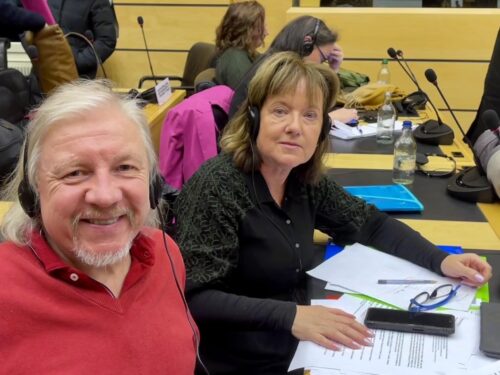
Atheist Ireland uses our special consultative status at the UN to highlight religious discrimination in Irish schools, and to counter inaccurate responses by the Irish state to UN human rights committees. Here are UN human rights recommendations to Ireland based on these sessions.
- Questions from Human Rights Committee 2014
- UN ICCPR (Civil and Political Rights) Concluding Observations 2023, 2014, 2008
- UN Rights of the Child Concluding Observations 2023, 2016, 2006
- UN ESC (Economic, Social, and Cultural) Rights Concluding Observations 2024, 2015
- UN CERD (Racial Discrimination) Concluding Observations 2020, 2011, 2005
- UN CEDAW (Discrimination against Women) Concluding Observations 2017
- We also have a page linking to Council of Europe recommendations to Ireland on this issue.
1. Questions from Human Rights Committee 2014
First, here are links to two short videos of Yuval Shany (UN Human Rights Committee) questioning the Irish delegation on religious discrimination in Irish School and access to nondenominational education on the examination of Ireland under the International Covenant on Civil and Political Rights in 2014.
https://www.youtube.com/watch?v=2v5_bmU5x7I
Mr. Shany also raised with the Irish delegation a legal point, whether the state believed or not that it was required to ensure a neutral studying environment in those schools outside the confines of the religious instruction class. This question was:
https://www.youtube.com/watch?v=-Q4UjpG9mow
“My follow-up question goes to the issue of denominational education, and I note the statement on improvements that are planned in the transparency of school admission policies. My two follow up questions in this regard are:
How does the Delegation explain the compatibility with the Covenant of a state of affairs that allows private schools, which have a near monopoly in Ireland on a vital public service, to openly discriminate in admission policies between children on the basis of their parents religious convictions? I would appreciate, whether orally or in writing, the Delegation’s theory on this point, on this legal point.
And whether the State believes or not that it is required to ensure a neutral studying environment in those schools, in denominational schools, outside the confines of religious instruction classes that can be opted out from?”
The Irish state never responded to these two questions.
2 UN ICCPR (Civil and Political Rights) Concluding Observations 2023, 2014, 2008
UN ICCPR Concluding Observations from 2023
Freedom of religion
41. The Committee welcomes the adoption of the Education (Admissions to Schools) Act 2018 to prohibit the use of religion as a selection criterion in primary school admissions and the measures taken towards the establishment of multi-denominational schools.
However, recalling its previous concerns, the Committee regrets the lack of information regarding access to secular education through the establishment of non-denominational schools.
The Committee is concerned that the provisions of the Act only apply to primary education and about reports that more than half of secondary schools are under religious patronage and operate with a religious ethos.
It is also concerned at the slow progress in amending the provisions of the Constitution that oblige individuals wishing to take up senior positions in public office to take religious oaths.
Furthermore, the Committee reiterates its previous concern that, under section 37 (1) of the Employment Equality Act, institutions under the direction or control of a body established for religious purposes, including in the fields of education and health, can discriminate against employees or prospective employees to protect the religious ethos of the institution (arts. 2, 18 and 26).
42. The Committee reiterates its previous recommendations that the State party should:
(a) Consider taking concrete steps to amend articles 12, 31 and 34 of the Constitution that require religious oaths to take up senior positions in public office, taking into account the Committee’s general comment No. 22 (1993) on freedom of thought, conscience and religion, concerning the right not to be compelled to reveal one ’ s thoughts or adherence to a religion or belief in public;
(b) Take the appropriate measures to provide secular education through the establishment of non-denominational schools and ensure the further amendment of section 37 (1) of the Employment Equality Act in a way that bars all forms of discrimination in employment in the fields of education and health.
UN ICCPR Concluding Observations from 2014
Freedom of religion
The Committee is concerned at the slow pace of progress in amending the provisions of the Constitution that oblige individuals wishing to take up senior public office positions, such as President, members of the Council of State and members of the judiciary, to take religiousoaths.
It is also concerned about the slow progress in increasing access to secular education through the establishment of non-denominational schools, divestment of the patronage of schools and the phasing out of integrated religious curricula in schools accommodating minority faith or non-faith children.
It expresses further concern that under section 37 (1) of the Employment Equality Acts, religious-owned institutions, including in the fields of education and health, can discriminate against employees or prospective employees to protect the religious ethos of the institution (arts. 2, 18, 25 and 27).
The State party should take concrete steps to amend articles 12, 31 and 34 of the Constitution that require religious oaths to take up senior public office positions, taking into account the Committee’s general comment No. 22 (1993) on freedom of thought, conscience and religion, concerning the right not to be compelled to reveal one’s thoughts or adherence to a religion or belief in public.
It should also introduce legislation to prohibit discrimination in access to schools on the grounds of religion, belief or other status, and ensure that there are diverse school types and curriculum options available throughout the State party to meet the needs of minority faith or non-faith children. It should further amend section 37 (1) of the Employment Equality Act in a way that bars all forms of discrimination in employment in the fields of education and health.
UN ICCPR Concluding Observations from 2008
The Committee continues to be concerned that judges are required to take a religious oath. (art. 18) The State party should amend the constitutional provision requiring a religious oath from judges to allow for a choice of a non-religious declaration.
The Committee notes with concern that the vast majority of Ireland’s primary schools are privately run denominational schools that have adopted a religious integrated curriculum thus depriving many parents and children who so wish to have access to secular primary education. (arts. 2, 18, 24, 26).
The State party should increase its efforts to ensure that non-denominational primary education is widely available in all regions of the State party, in view of the increasingly diverse and multi-ethnic composition of the population of the State party.
3 UN Rights of the Child Concluding Observations 2023, 2016, 2006
Rights of the Child Concluding Observations 2023
Non-discrimination
14. The Committee welcomes the establishment of the Anti-Racism Committee but remains concerned about persistent discrimination against children of minority groups and those in disadvantaged situations.
15. The Committee recommends that the State party:
(a) Ensure that the legal framework on discrimination adequately protects children from discrimination and expeditiously conclude and implement its review of the Equality Acts, that children effectively know how to report cases of discrimination, and that cases of discrimination against children are fully investigated and the perpetrators held to account;
(b) Launch without delay the national action plan against racism and allocate sufficient resources for its implementation, designate an entity responsible for the implementation and monitoring of the plan and ensure that children of minority groups can participate in the evaluation and optimisation of the plan;
(c) Ensure systematic training on the protection of children from discrimination, including hate speech and hate crime, for law enforcement officials, the judiciary, prosecutors and other professionals working with and for children;
(d) Strengthen measures to eliminate discrimination against Traveller and Roma children, children of African descent, children of minority faith or non-faith backgrounds, children in socioeconomically disadvantaged situations, lesbian, gay, bisexual, transgender and intersex children, children without regular residence status, children of Catholic priests, children of unmarried parents, and asylum-seeking, refugee and migrant children. Also, where appropriate, ensure their access to adequate accommodation, health care, education and a decent standard of living, and ensure regular and systematic monitoring and impact assessments of the measures taken.Freedom of thought, conscience and religion
21. The Committee urges the State party to guarantee the right of all children to practise freely their religion or belief, including by:
(a) Amending the Education (Admission to Schools) Act 2018 and the Equal Status Acts to remove any exceptions to ensuring a child’s right to education in all primary and secondary schools based on religious or “ethos” grounds, and establish statutory guidelines to ensure children’s right not to attend religious classes;
(b) Developing a time-bound strategy, with adequate resources, for meeting its targets for increasing the availability of multi-denominational schools by 2030 and setting a target with a time-bound strategy and adequate resources for increasing the availability of non-denominational schools.
Rights of the Child Concluding Observations 2016
Freedom of thought, conscience and religion
35. The Committee is concerned that children are not ensured the right to effectively opt-out of religious classes and access appropriate alternatives to such classes.
36. The Committee recommends that the State party ensure accessible options for children to opt-out of religious classes and access appropriate alternatives to such classes, in accordance with the needs of children of minority faith or non-faith backgrounds.H. Education, leisure and cultural activities (arts. 28, 29, 30 and 31)
63. The Committee welcomes the establishment of the Forum on Pluralism and Patronage in the Private Sector to attempt addressing the need for diversity in the types of schools available to children in the State party. However, the Committee remains concerned at the very small number of non-denominational schools. The Committee is also concerned about:
(a) Schools continuing to practise discriminatory admissions policies on the basis of the child’s religion and/or whether his or her parent(s) are former students of the school; (b) Incomplete complaints-handling structures in the education sector; (c) The pressure that the Leaving Certificate Examination places on children; and, (d) Insufficient physical activities in school, which can be enjoyed by all students.64. The Committee recommends that the State party:
(a) Expeditiously undertake concrete measures to significantly increase the availability of non-denominational or multidenominational schools and to amend the existing legislative framework to eliminate discrimination in school admissions, including the Equal Status Act;
(b) Establish an effective complaints mechanism for students in schools; (c) Consider reforming the Leaving Certificate Examination with a view to reducing the stress caused to children by it; and, (d) Develop curriculum of physical leisure activities which can be enjoyed by all students.
Rights of the Child Concluding Observations 2006
60. The Committee reiterates the concern raised by the Committee on the Elimination of Racial Discrimination (CERD/C/IRL/CO/2) that non-denominational or multidenominational schools represent less than 1 per cent of the total number of primary education facilities.
61. The Committee encourages the State party to take fully into consideration the recommendations made by the Committee on the Elimination of Racial Discrimination (CERD/C/IRL/CO/2, para. 18) which encourages the promotion of the establishment of non-denominational or multi-denominational schools and to amend the existing legislative framework to eliminate discrimination in school admissions.”
4 UN ESC (Economic, Social, and Cultural) Rights Concluding Observations 2024, 2015
UN ESC Rights Concluding Observations 2024
Right to education
52. The Committee regrets the lack of statistical data on school enrolment, dropout and irregular attendance rates in primary, secondary and tertiary education and on educational achievement and results, disaggregated by age, sex, ethnic origin, national origin, disability status and socioeconomic status. The Committee is concerned about:
(a) The significant increase in the number of special classes and schools for children with disabilities;
(b) The persistent obstacles faced by Roma children, Traveller children and children from disadvantaged backgrounds in gaining access to and remaining in the State’s education system without discrimination;
(c) The persistence of significant inequalities in educational attainment, in particular for children belonging to ethnic, religious or other minorities and children from low-income families, which has the effect of limiting social mobility;
(d) The narrow approach towards the provision of sexual and reproductive health education (arts. 13 and 14).53. The Committee recommends that the State party:
(a) Collect and analyse data disaggregated by age, sex, ethnic origin, national origin, disability status and socioeconomic status on attendance and completion rates and educational outcomes to assess the enjoyment of the right to education by different groups and to take targeted measures to ensure their equal access to quality education;
(b) Prioritize inclusive education in early childhood education and mainstream schools for all children with disabilities by adapting curricula and training, assigning specialized teachers and professionals to integrated classes so that children with disabilities and learning difficulties receive individual support and due attention and ensuring reasonable accommodation within the school infrastructure and for transportation;
(c) Ensure that Roma children, Traveller children and children from disadvantaged backgrounds have access to quality education that is culturally appropriate and adapted to their needs;
(d) Introduce targeted measures to raise educational attainment rates among children from disadvantaged backgrounds and those from low-income families, with a view to promoting social mobility;
(e) Introduce comprehensive, age-appropriate sexual and reproductive health education for both genders in primary and secondary curricula, including comprehensive sex education for adolescent girls and boys covering responsible sexual behaviours and focused on preventing early pregnancies, and ensure that sex education is scientifically objective and that its delivery by schools is closely monitored and evaluated;
(f) Refer to the Committee’s general comment No. 13 (1999) on the right to education.
UN ESC Rights Concluding Observations 2015
Non-discrimination
12. While noting the existence of a number of laws, including the Equality Status Act 2000, to provide equality provisions in the State party, the Committee is concerned that these laws do not provide a full range of grounds of discrimination prohibited by the Covenant (art. 2 (2)).
The Committee recommends that the State party adopt comprehensive anti-discrimination legislation that includes all the grounds for discrimination set out in article 2 (2) of the Covenant. The Committee refers in this regard to its general comment No. 20 (2009) on non-discrimination in economic, social and cultural rights.
Right to education
31. The Committee is concerned at the discrimination faced by children with disabilities, migrant children, children belonging to a religious minority, Traveller and Roma children, including:
(a) Legal provisions, such as section 7 of the Equal Status Act 2000, which allow schools to give preference to admission of students based on religion;
(b) Discriminatory criteria against children with special educational needs contained in many admissions policies and the lack of a regulatory framework;
(c) Adverse effects of the austerity measures on the education sector, including the reduced number of teachers, rationalization of teacher/student support services, abolition of grants to schools, increase in transport charges and reduced allowance for clothing and footwear, which further restrict disadvantaged children from attending schools (arts. 13 and 14).The Committee recommends that the State party:
(a) Take all the measures necessary to bring all relevant laws, including the Equal Status Act 2000 and the Education (Admission to Schools) Bill 2015 in line with international human rights standards and to increase the number of non-denominational schools at the primary and post-primary education levels;
(b) Review admissions policies of all schools with a view to removing all discriminatory criteria for enrolment and establish a regulatory mechanism to monitor school policies, including admissions policies;
5 UN CERD (Racial Discrimination) Concluding Observations 2020, 2011, 2005
UN CERD Concluding Observations 2020
Legislative framework for the elimination of racial discrimination
11. The Committee is concerned about the following shortcomings in the Equal Status Acts 2000 to 2018 and the Employment Equality Acts 1998 to 2015:
(a) The absence of all prohibited grounds of racial discrimination in conformity with article 1 of the Convention;
(b) The absence of explicit prohibition of multiple or intersectional discrimination;
(c) The unclear definition of “services” in section 5 of the Equal Status Acts, which may exclude the provision of services provided by public authorities such as the police, the prison service and the immigration service;
(d) Preclusion of complaints against legislative provisions in section 14 of the Equal Status Acts (arts. 1 and 2).12. The Committee recommends that the State party review the Equal Status Acts 2000 to 2018 and the Employment Equality Acts 1998 to 2015 with a view to:
(a) Bringing the definition of racial discrimination provided for in these Acts in line with article 1 of the Convention;
(b) Providing for explicit prohibition of multiple or intersectional discrimination;
(c) Explicitly including the functions of public authorities within the definition of the “services” in section 5 of the Equal Status Acts;
(d) Ensuring that an effective remedy with a legislative basis is provided for victims of discrimination.Education of minority children
29. The Committee welcomes the enactment of the Education (Admission to Schools) Act 2018, which repeals a provision that permits primary schools to use religion as a selection criterion. However, the Committee regrets the lack of information on the impact of this measure (arts. 5 and 7).
30. Recognising the intersectionality between ethnic and religious discrimination, the Committee recommends that the State party provide, in its next periodic report, information on the outcome of this measure. It also recommends that the State party monitor school admissions to ensure full compliance by schools, encourage diversity and tolerance of other faiths and beliefs in the education system and monitor incidents of discrimination based on belief.
UN CERD Concluding Observations 2011
1. The Committee considered the third and fourth periodic reports of Ireland, submitted in one document (CERD/C/IRL/3-4), at its 2063rd and 2064th meetings (CERD/C/SR.2063 and 2064), held on 22 and 23 February 2011. At its 2089th meeting (CERD/C/SR 2089), held on 9 March 2011, it adopted the following concluding observations.
26. The Committee recalls its previous concluding observations (CERD/C/IRL/CO/2) and notes with concern that the education system in the State party is still largely denominational and is mainly dominated by the Catholic Church. The Committee further notes that non-denominational or multi-denominational schools represent only a small percentage of the total and, regrets that, according to reports, there are not enough alternative schools, and students of the Catholic faith are favoured for enrolment intoCatholic schools against students of other faiths in case of shortage of places. The Committee further expresses its regret that the provisions of the Equal Status Act give the power to schools to refuse to admit students to denominational schools on grounds of religion if it is deemed necessary to protect the ethos of the school (articles 2, 5(d)(vii) and 5(e)(v))
Recognising the ‘intersectionality’ between racial and religious discrimination, the Committee reiterates its previous concluding observations (CERD/C/IRL/CO/2) and recommends that the State party accelerates its efforts to establish alternative non-denominational or multi-denominational schools and to amend the existing legislation that inhibits students from enrolling into a school because of their faith or belief. The Committee further recommends to the State party to encourage diversity and tolerance of other faiths and beliefs in the education system by monitoring incidents of discrimination on the basis of belief.
UN CERD Concluding Observations 2005
18. The Committee, noting that almost all primary schools are run by Catholic groups and that non-denominational or multi-denominational schools represent less than 1% of the total number of primary educational facilities, is concerned that existing laws and practice would favour Catholic pupils in the admission to Catholic schools in case of shortage of places, particularly in the light of the limited alternatives available. (article 5(d)(vii) and 5(e)(v))
The Committee, recognising the “intersectionality” of racial and religious discrimination, encourages the State party to promote the establishment of nondenominational or multi-denominational schools and to amend the existing legislative framework so that no discrimination may take place as far as the admission of pupils (of all religions) in schools is concerned.
19. The Committee is concerned that the non-discrimination requirement stipulated in the 2000 Equal Status Act only covers Government functions falling within the definition of a “service” as defined by the Act itself (art. 5 (f)).
In order to ensure comprehensive protection against discrimination by public authorities, the Committee urges the State party to consider expanding the scope of the Equal Status Act so as to cover the whole range of Government functions and activities, including controlling duties.
6 UN CEDAW (Discrimination against Women) Concluding Observations 2017
UN CEDAW Concluding Observations 2017
Education
38. The Committee welcomes the number of measures taken to further improve women’s and girls’ access to quality education such as the Better Outcomes, Brighter Futures (2014-2020) framework, which acknowledges the need to pay particular attention to the need to develop girls’ skills in science, technology, engineering and mathematics. It also welcomes the fact that a number of academic institutions have signed up to the Athena SWAN Charter, which seeks to advance women’s careers in science, technology, engineering and mathematics. The Committee further welcomes the introduction of a new short course in social, personal and health education for the junior cycle. Nevertheless, the Committee is concerned at:
(a) Reports of stereotypes and sexism in the field of education, and at the lack of concrete measures to curb this phenomenon;
(b) The gender approach of the apprenticeship training programme, which has the effect of attracting few women and girls;
(c) The narrow approach towards the provision of sexuality education, owing to the fact the content of the relationship and sexuality education curriculum is left to institutions to deliver according to their individual ethos and values and as a result it is often taught together with courses on biology and religion;
(d) The fact that Traveller, Roma and migrant women and girls have low levels of education.39. The Committee recommends that the State party:
(a) Strengthen its strategies, including through the use of temporary special measures, to address discriminatory stereotypes and sexism in the field of education that deter women and girls from pursuing a career in education and rising to the higher echelons of academic positions;
(b) Ensure that the Review of Apprenticeship Training in Ireland (2014) informs the development of a gender-neutral approach to apprenticeships and that the implementation of Ireland’s National Skills Strategy 2025 focuses on increasing the participation of women and girls in apprenticeships;
(c) Integrate compulsory and standardized age-appropriate education on sexual and reproductive health and rights into school curricula, including comprehensive sex education for adolescent girls and boys covering responsible sexual behaviours and focused on preventing early pregnancies, and ensure that sex education is scientifically objective and its delivery by schools is closely monitored and evaluated;
(d) Take appropriate remedial action to address the low levels of education attainment among Traveller, Roma and migrant women, including through the use of temporary special measures, such as scholarships, and non-stereotypical career counselling consultation on educational plans and processes, and provide information in the next periodic report on the impact of the Education (Admissions to Schools) Bill 2016, particularly of the past –pupil criteria, on access to education by Traveller, Roma and migrant women and girls.
7. Council of Europe Recommendations
We also have a page linking to Council of Europe recommendations to Ireland about religious discrimination in Irish schools.